
Most operations do not break all at once. They erode slowly, and rarely because of the people inside them.
A few extra meetings here. Another dashboard there. A planning cycle skipped because the business is too busy. Teams start reacting instead of preparing. Process documentation that never got written down, so accountability erodes every time someone new joins the team. Before long, the organization is running on best intentions instead of operational discipline. The scrappy approach that worked at 50 orders a day stops working at 500, and the cracks compound faster than the team can patch them.
I have seen this pattern play out repeatedly across supply chains, fulfillment operations, and logistics networks. The irony is that many struggling organizations are filled with smart, hardworking people. The issue is rarely effort. The issue is foundations, or the operational consistency, accountability, and scalability.
According to Gartner’s 2025 Supply Chain Technology User Wants and Needs Survey, supply chain leaders continue to rank operational resilience and execution agility among their top priorities as volatility across labor, transportation, inventory, and demand planning continues to intensify. McKinsey’s research on operations maturity estimates that companies with mature operational systems can respond to disruption much faster than peers because decision-making and accountability mechanisms are already established.
The companies scaling effectively today are not necessarily the ones with the most technology. They are the ones with the strongest operational foundations.
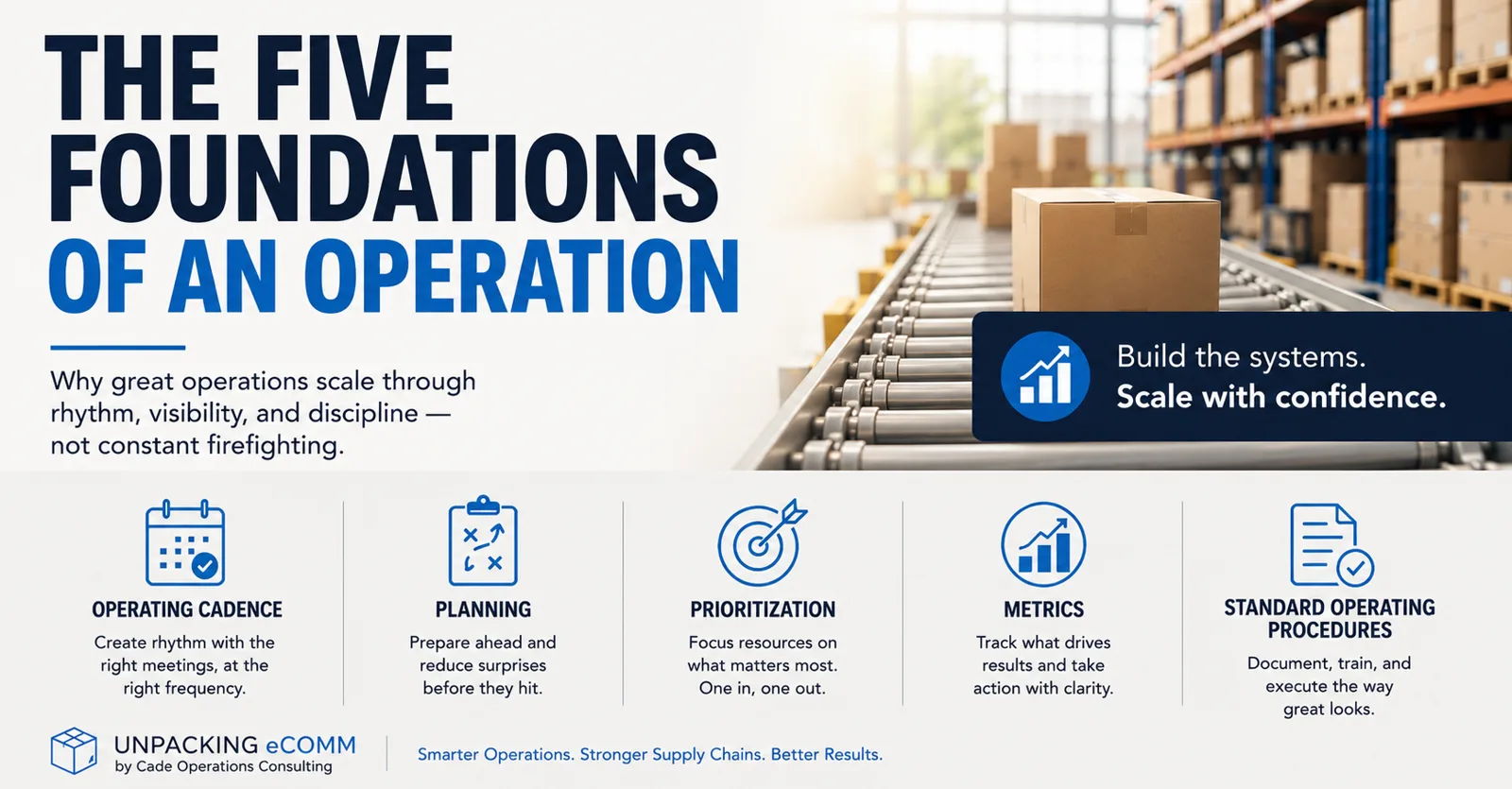
Over time, I have come to think about those foundations as five foundational pillars: Operating Cadence, Planning, Prioritization, Metrics, and Standard Operating Procedures. Building on each other, they move organizations from reactive execution to scalable execution.
Pillar 1: Operating Cadence
Great operations run on rhythm, not reaction. One of the fastest ways to assess an organization’s health is to look at its calendar.
Healthy operations have clear review mechanisms, structured communication, consistent accountability, and recurring forums for decision-making. When that rhythm is missing, the default is endless one-off meetings, reactive escalations, and constant context-switching. A culture forms where having more meetings become a badge of honor, when really it’s a symptom of missing structure.
That creates two major problems.
First, it exhausts teams. People need time to think and time to do, and constant context-switching kills both. The constant need to learn new templates, attend ad hoc meetings, or reinterpret shifting priorities every week is inefficient.
Second, it blurs leadership altitude. I’ve watched leaders simultaneously trying to solve frontline execution issues, set long-term strategy, coach talent, and manage escalations. The 1:1s that should develop their people get canceled. The strategic thinking that should be happening at the leadership level gets crowded out by fires that a well-designed cadence would have caught earlier.
The fix isn’t more meetings. It’s the right meetings, at the right frequency, with clear owners and consistent agendas so accountability happens by design, not by chase.
| Cadence | Forum | What Good Looks Like |
|---|---|---|
| Weekly | Weekly Business Review (WBR), Labor and Staffing plans | Key metrics reviewed with owners, trend context, and specific actions |
| Monthly / Quarterly | Business health, roadmap review, and people development cadence | Capacity planning, hiring & labor type shifts, initiative progress vs. plan, 1:1s, people development actioning |
| Annual | Strategic planning cycle for both business and people development | Labor comp review, org health assessment, 12-month strategy and resource alignment, people development strategy, labor models and compensation |
The specifics will vary by operation, but the principle holds: build the rhythm intentionally and protect it. A WBR that gets canceled every other week isn’t a WBR, but a recurring invite.
Pillar 2: Planning
Every operation pays for poor planning eventually. The only question is how.
Some pay through excessive overtime, inventory shortages, missed customer promises, and eventual leadership burnout. Others try to compensate by building buffers: excess labor, excess inventory, excess capacity. Both approaches may temporarily stabilize the operation, but both come with significant cost.
Good planning isn’t about forecasting perfectly. Modern supply chains move too fast for that. It’s about reducing surprises early enough for your team to respond rationally rather than emotionally. The difference between “we saw this coming two weeks ago and adjusted” and “we’re scrambling because no one showed up after the Super Bowl” is always a planning failure, not an execution one.
Leaders sometimes resist committing to plans built on assumptions. The uncertainty feels uncomfortable. But operating without stated assumptions isn’t safer, it just means the assumptions are obscured. Making assumptions explicit is what lets you course-correct and react deliberately.
Strong planning answers four questions: What do we know? What do we expect? What could change? And what’s our trigger to respond? Build those answers across layered horizons—daily execution, weekly labor, monthly inventory and capacity reviews, quarterly strategic planning—and you move from a team that’s always surprised to one that’s almost never caught flat-footed.
Pillar 3: Prioritization
Most organizations are not short on ideas. They are short on focus.
Operations teams are often filled with ambitious people. That is usually a strength… until every opportunity becomes a priority.
Then the organization starts trying to boil the ocean. Projects pile up. Resources fragment. Teams stay busy, but meaningful progress stalls. I’ve seen organizations simultaneously run process redesigns, new reporting builds, labor mode changes, automation pilots, and network optimization efforts, and discover six months later that not one of them fully landed. The teams were exhausted. The initiatives were half-baked. And the operation wasn’t meaningfully better.
Part of the problem is how things get on the list. A senior leader mentions something in a meeting and it’s suddenly a priority. An analyst builds a dashboard for the “hot item” today, but now it needs to be maintained separately as opposed to an integrated dashboard. That’s not prioritization.
Strong operations create intentional prioritization mechanisms. One of the simplest and most effective approaches is maintaining a visible operational parking lot where every idea is captured, initiatives are ranked against business impact, ownership is clearly assigned, and killing or pausing an initiative is treated as seriously as launching one.
Sequencing matters more than most teams realize. Some foundational capabilities—the unglamorous ones—must exist before higher-visibility initiatives can succeed.
The goal isn’t to launch everything. It’s to finish the most important things completely, operationalize them, and then pull the next priority off the list.
Pillar 4: Metrics
Too many organizations drown in data while starving for clarity because visibility alone does not create progress. Metrics should tell teams what to do next. Knowing that inventory accuracy is at 94% tells you something is wrong. Knowing that accuracy drops to 81% in the returns processing zone on Mondays, and then an additional 4% on Tuesdays, tells you exactly where to act. That distinction is the difference between a metric that informs and one that drives.
One framework I frequently use is to start with the output metric you care about and work backward until you reach a controllable operational input.
| Output Metric | Input Metrics | Actionable Driver |
|---|---|---|
| Customer Promise | Pick speed | Pick path optimization |
| Inventory availability | Receiving speed | Trailer unload sequencing |
| Transportation cost | Trailer cube utilization | Shipment consolidation behavior |
Frontline teams that can’t manage high-level business outcomes directly. They manage the operational behaviors that drive them. A useful rule: if a frontline manager cannot directly influence the metric, it is probably too high-level for daily or weekly performance conversation.
The reverse is equally true. Your VP doesn’t need to review trailer unload sequencing in a leadership meeting. Metrics should build across levels, each one feeding up into the next, not duplicating or contradicting.
Pillar 5: Standard Operating Procedures (SOPs)
If the process lives only in people’s heads, the operation is fragile.
Without clear standard operating procedures, training becomes inconsistent, accountability becomes subjective, and improvement becomes nearly impossible as you can’t optimize a process you haven’t defined.
Good SOPs are not written for auditors. They are written for operators. That means they’re easy to find, easy to understand, operationally practical, and actively maintained, which means someone owns and reviews them when the process changes.
The best SOPs also create scalability, and answer these four questions without ambiguity: How should the work happen? Who owns it? What does good performance look like? And what exceptions require escalation?
One of the simplest leadership tests is this: “Could a new manager successfully run this process using only the documentation available today?”
If the answer is no, organizations have hidden risk sitting in the institutional knowledge of specific people. When those people leave, get promoted, or go on extended leave, the operation suffers in ways that are entirely predictable and preventable.
Strong SOPs institutionalize learning. They transform what your best operators know into something the whole team can execute. That’s not bureaucracy. That’s how you scale.
Conclusion
The strongest operations are rarely the loudest or most chaotic. They’re usually the most disciplined. Over time, I have found that scalable operations consistently build the same foundational layers.
Cadence creates rhythm so the right conversations can happen at the right frequency. Planning creates preparedness so surprises become exceptions rather than the norm. Prioritization creates focus so your best people are working on the highest-leverage problems. Metrics create visibility so teams know what “good” looks like and where the gaps are. And SOPs create consistency, so execution doesn’t depend on who happens to be working that shift.
None of these are complicated in isolation. The challenge is building all five together, and maintaining them as the business changes. That’s the work. And it’s the work that separates operations that scale from operations that feel like they’re one bad week away from failing.