
Most mid-market leaders can tell you their gross margin to the decimal point. Ask them which customers, channels, or products are actually profitable once you factor in how they're served, and the answers get fuzzy fast.
That gap is expensive. Companies make pricing decisions, channel investments, and network bets using averages. Averages hide the customers who cost twice as much to serve as the rest. They hide the SKUs that look profitable until you account for how they move through the warehouse. They hide the service commitments your sales team has been making for years without anyone calculating what they actually cost to deliver.
Cost to serve is how you close that gap. Done well, it changes the conversations your leadership team is having. Done poorly, it becomes another model that nobody trusts and nobody uses.
The difference usually comes down to who's driving the work.
Why Cost to Serve Matters Now
The environment has changed in ways that punish companies relying on gut and averages.
Customer expectations keep rising. Faster delivery, tighter service windows, more flexibility on returns and exchanges. Every one of those expectations has a cost, and most companies have absorbed them without re-pricing or re-segmenting the customers driving them.
Channel complexity has exploded. A company that used to ship pallets to a handful of distributors now sells through distributors, direct-to-retail, eCommerce, marketplaces, and whatever channel the sales team closed last quarter. Each one has a different cost profile, and the blended P&L tells you almost nothing about which ones are carrying the others.
Cost pressure is relentless. Labor, freight, and facility costs have all stepped up, and they're not coming back down. Companies that can't see where cost lives can't take it out with precision. They cut across the board, which usually means cutting good cost alongside bad.
The companies that thrive in this environment aren't the ones with the lowest costs. They're the ones that understand their costs at a level of resolution that lets them make sharper decisions. Cost to serve is how they get there.
A Finance and Operations Partnership
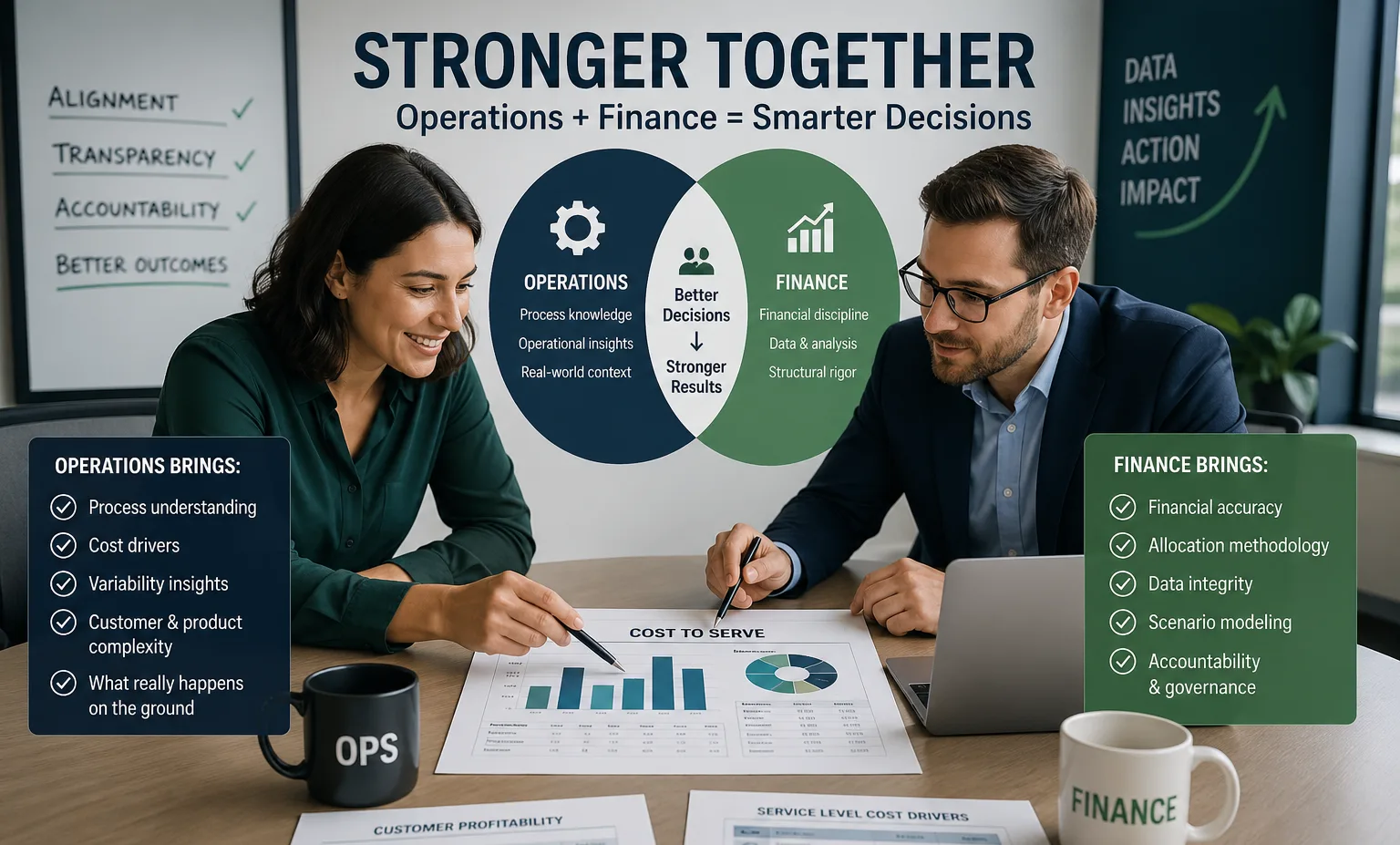
Cost to serve often starts inside finance, and for good reason. Finance owns the P&L. Finance knows how to allocate. Finance has the modeling chops to build something rigorous. That foundation matters.
What finance can't do alone is explain why the costs exist in the first place. Allocations describe where dollars land. They don't describe the process that consumed them. That's where operations has to come in, and it's where a lot of CTS efforts lose their footing.
Operations knows which SKUs move through the warehouse differently and why. Operations knows that LTL and parcel economics aren't interchangeable, even when they show up in the same freight line on the P&L. Operations knows which customers generate exception handling that doesn't show up anywhere obvious in the books. When that context isn't in the model, operators see their own processes reflected back to them in ways that don't match reality, and they stop engaging. Leadership picks up on the skepticism. The model quietly loses authority.
The companies that build cost to serve as a durable capability treat it as a joint effort from the start. Finance anchors the structure and keeps the math honest. Operations walks the floor, sits with the planners and pickers and customer service reps, and makes sure the cost drivers in the model reflect what actually drives cost in the business. Both perspectives are essential. The model is stronger when they're built in together rather than bolted on in sequence.
Common Pitfalls
Even with the right orientation, CTS projects get derailed in predictable ways.
Boiling the ocean. Teams try to model every cost, every channel, every customer, every SKU from day one. The scope balloons, the timeline slips, stakeholders lose interest, and the model that eventually ships is so complex that nobody trusts it or updates it. Cost to serve should be built in layers, not in one pass.
Treating it as a one-time project. A CTS model built for a single strategy offsite is worth something. A CTS capability that's refreshed quarterly and feeds into pricing, network, and customer decisions is worth orders of magnitude more. Companies that stop at the deliverable miss most of the value.
Over-engineering the tooling. We've seen companies spend six months building a dashboard before anyone has validated the underlying cost logic. When the logic turns out to be wrong, the dashboard has to be rebuilt from the ground up. Get the math right first. Visualize it later.
Averaging overhead without thinking. Not every cost deserves a driver-based allocation. Some overhead genuinely does get consumed uniformly and can be averaged. But companies that average everything out of convenience end up with models that can't explain the variation leadership is asking about. Know which costs behave which way, and treat them accordingly.
Ignoring what the model is for. CTS isn't an end in itself. It's an input to pricing decisions, customer segmentation, network design, and service level policy. Teams that build the model without a clear view of how it'll be used end up with something technically correct and practically useless.
How to Actually Get This Done
The companies that build cost to serve well tend to follow a similar pattern.
Start with one domain. Pick the area where you have the most operational complexity and the best data. For one wholesale distributor we worked with, that was under-the-roof warehouse costs: receiving, putaway, storage, pick, pack, and white-glove handling. We built the logic there first, working directly with operations leaders to validate the process map and the rates. Getting those numbers right and defensible gave the project credibility. That credibility is what pulled transportation and customer service into the work. Trying to do all three functions at once would have produced something nobody believed in any of them.
Tier your cost components. Some costs vary meaningfully at the SKU or customer level and deserve real modeling. Some are smaller or more uniform and can be handled with simpler allocations. Some are overhead that gets spread across the business. Being explicit about which bucket each cost falls into keeps the model from collapsing under its own weight.
Validate with operators before rolling up. The fastest way to kill a CTS model is to present final numbers to leadership before the people running the operation have seen them. Build in review checkpoints with the operators closest to each process. Their pushback will make the model better, and their endorsement will make it credible when it reaches the C-suite.
Keep the tooling proportional to the maturity. Early on, a well-structured Excel model beats a polished dashboard. It's easier to iterate, easier to audit, and easier for operators to engage with. Dashboards come later, once the logic is stable and the consumers of the numbers know what they need.
Build for refresh, not just for the deck. Design the model so that next quarter's data can flow in without a three-week rebuild. That's what turns a project into a capability.
How Cade Ops Helps
Cade Ops is a team of former operators. We've led fulfillment networks at Amazon, run supply chain strategy at Walmart, and sat in the COO seat at mid-market companies going through exactly the kinds of transitions we now advise on. That operator DNA is why our cost-to-serve work lands differently than a traditional consulting engagement. We don't show up with a template and a finance lens. We walk the floor, sit with your teams, and build models rooted in how your operation actually runs.
We work in focused sprints with defined scope, so you see progress in weeks, not quarters. And because we stay close to execution, the work doesn't end with a deck. It shows up in the metrics your team tracks, the decisions your leadership makes, and the habits that stick after we're gone.
The Bottom Line
Cost to serve isn't a spreadsheet. It's a lens for seeing your business more clearly. Companies that build it well make sharper decisions across pricing, network, customer segmentation, and service levels. Companies that don't keep running their business on averages, and averages are where margin quietly disappears.
The mid-market companies that figure this out in the next few years will open a real gap on the ones that don't. The good news is the work is achievable. Start with one domain, involve your operators, and build the capability one layer at a time.