
It’s the Final (Mile) Countdown
Who will “win”? I’ve been asked this question more times than I can count. And while the reality is that eCommerce is not a zero-sum game (i.e. there’s room for multiple winners), the differences between Amazon’s and Walmart’s eCommerce operations matter deeply. Especially in the final mile.
If you know where to look, the contrasts are striking: how each company built its delivery network, what trade-offs they made between speed, cost, and control, and how those choices show up in customer experience and unit economics today. Those differences don’t just determine who ships faster. They shape margins, scalability, and long-term strategic flexibility.
Intro to eComm Operations Finance
In eCommerce operations, the economic engine starts well before a package ever hits the road. First-mile fulfillment, where inventory is received, stored, picked, and packed, is one of the few places a retailer can exert tight control. Decisions about where to place inventory relative to demand, how to slot products to maximize units per box, and how much automation to deploy directly influence labor productivity and space utilization. Efficient first-mile fulfillment drives lower cost per unit shipped by setting up the rest of the supply chain for success.
After orders leave the fulfillment center, the focus shifts to middle-mile logistics, where companies balance speed and cost by choosing between direct high-cost freight lanes or consolidated moves through sortation hubs that fill full trailers: a classic trade-off between speed and transportation yield.
At the far end sits the last-mile delivery, the final leg from local hub to customer doorstep. This segment is inherently the least controllable: routes are fragmented, customer locations are dispersed, and density (how many deliveries occur per square mile or per driver route) becomes the principal lever for cost efficiency. Because of these factors, last-mile delivery now accounts for roughly 40–55 % of total shipping costs in eCommerce operations, making it the most expensive and visible battleground in the network.
The Break Down
When people compare Amazon and Walmart’s ability to drive density in their networks, the first number most jump to is volume. It’s true that Amazon’s online sales footprint is substantially larger than Walmart’s. Amazon still leads U.S. eCommerce by a wide margin, capturing roughly ~40% of online retail spend versus Walmart’s ~10% share1. But Walmart is gaining ground quickly, and so we need to look at other important levers when it comes to density and cost efficiency.
There are three other visible levers that determine how successfully a network densifies delivery routes and thereby compresses unit cost:
Physical Infrastructure
On Road Vehicles
Technology
Amazon and Walmart take different approaches across each of these levers, and those differences show up directly in how dense and cost-effective their last-mile delivery networks are.
Physical Infrastructure
Ever wonder why you sometimes see multiple Amazon delivery vehicles arrive at your residence on the same day? The answer lies in how Amazon designed its last-mile infrastructure.
To make this concrete, look at Amazon’s physical footprint in a major metro like Houston.
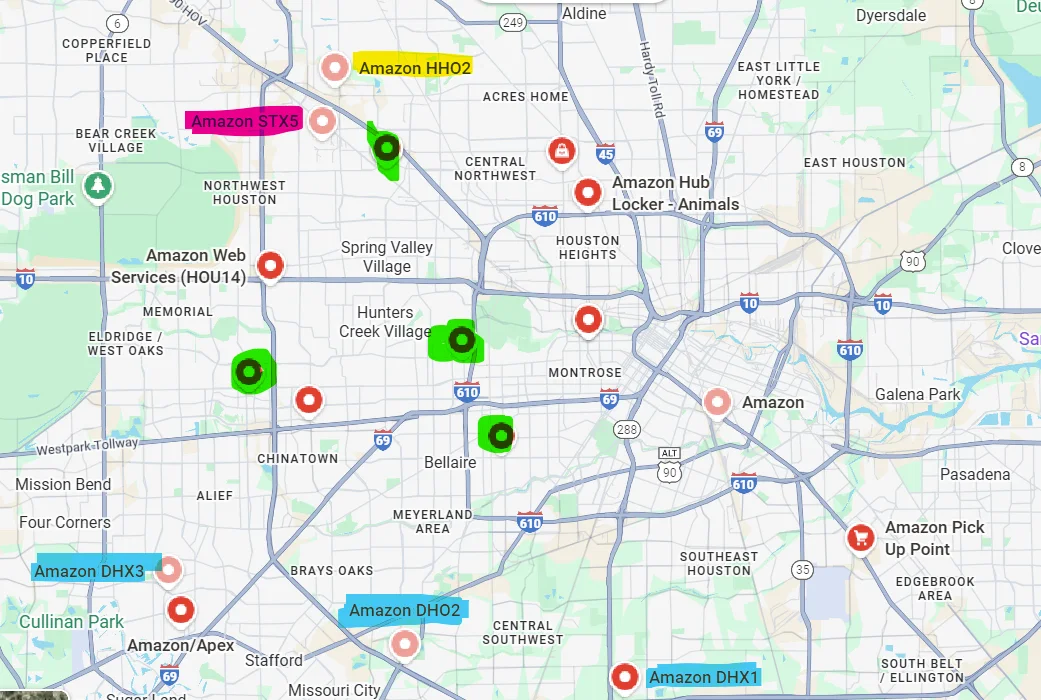
Each color represents a distinct delivery network, not just a different building. Amazon’s last-mile infrastructure reflects an eCommerce-first growth mindset. To support rapid expansion, speed promises, and an ever-broadening product assortment, Amazon intentionally built multiple specialized facility types, each optimized for a specific parcel size, delivery speed, or product category.
That specialization fueled growth, but it also created a structural headwind for unit economics. Because inventory and fulfillment are physically segmented across facility types, a single customer can trigger multiple deliveries in the same day: one vehicle for grocery, another for small or medium parcels, another for ultra-fast delivery, and another for oversized items. From a density standpoint, this is costly. Delivery vehicles often serve the same neighborhoods independently, reducing stops per route and increasing cost per delivery.
Now compare that to Walmart.
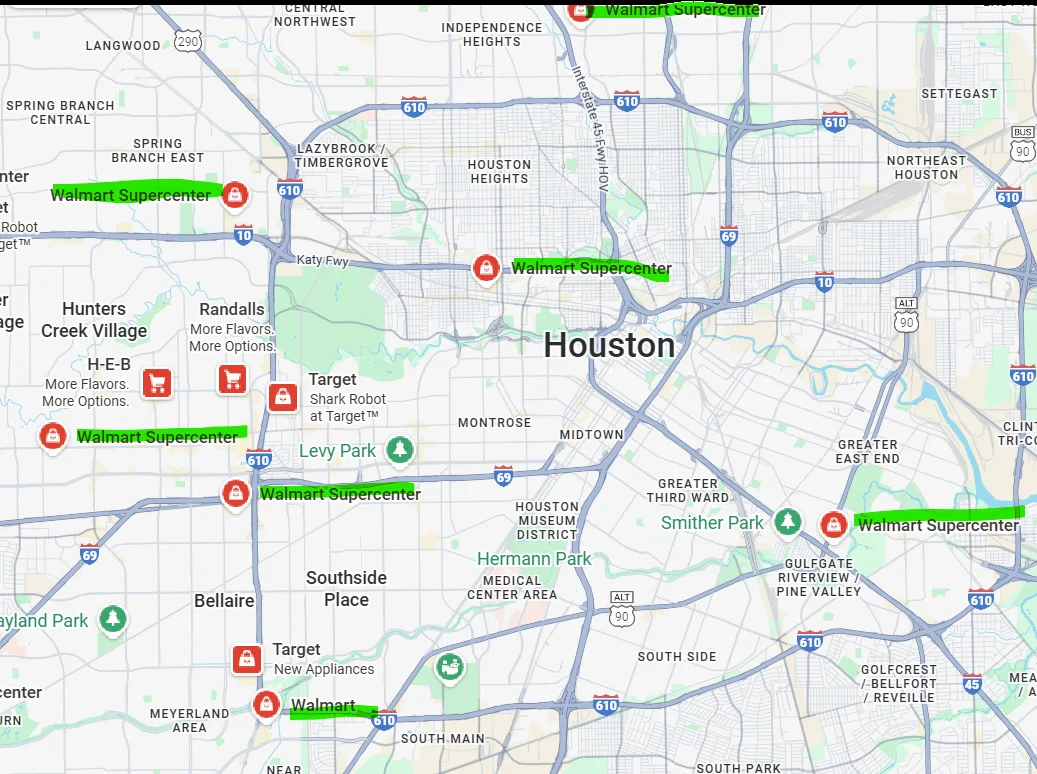
Walmart also operates a dense physical network, but with a fundamentally different design philosophy. Built for retail, Walmart co-locates large, small, and grocery inventory under one roof. Items not stocked in-store are shipped to the store first, where they can be combined with in-store inventory before heading to the customer. As a result, Walmart can typically consolidate orders into a single delivery visit.
From a last-mile economics perspective, this creates a meaningful tailwind: fewer trips to the same address, higher stop density per route, and lower cost per order. Walmart’s infrastructure, designed decades ago for physical retail, now acts as a structural advantage in last-mile delivery in ways Amazon’s more fragmented network must work harder to overcome.
This pattern holds when we look beyond dense metros and into rural and semi-rural markets as well. Shift the map west of Houston and follow the I-10 corridor toward San Antonio - roughly a two-hour drive that includes dozens of smaller communities and exurban households.
Along this corridor, Walmart’s physical presence is immediately visible. Multiple Walmart stores are positioned to serve local demand across grocery, small parcel, and large-parcel, allowing the network to aggregate volume from surrounding towns and route deliveries with built-in density.
Amazon’s footprint, by comparison, is far lighter and in some stretches, effectively absent. Without nearby delivery infrastructure, Amazon must serve these areas from more distant nodes, which increases linehaul distance, reduces route density, and pushes more cost into the last mile.
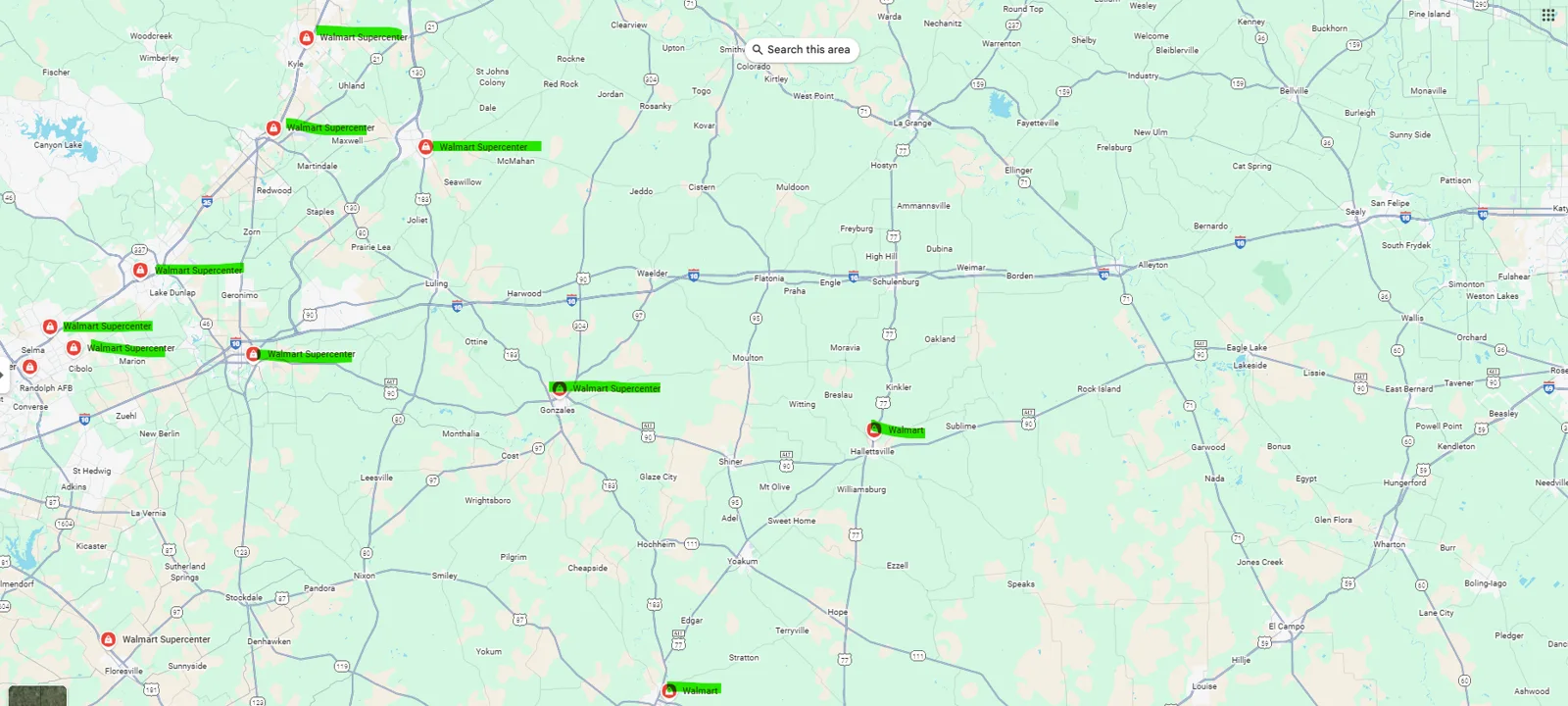
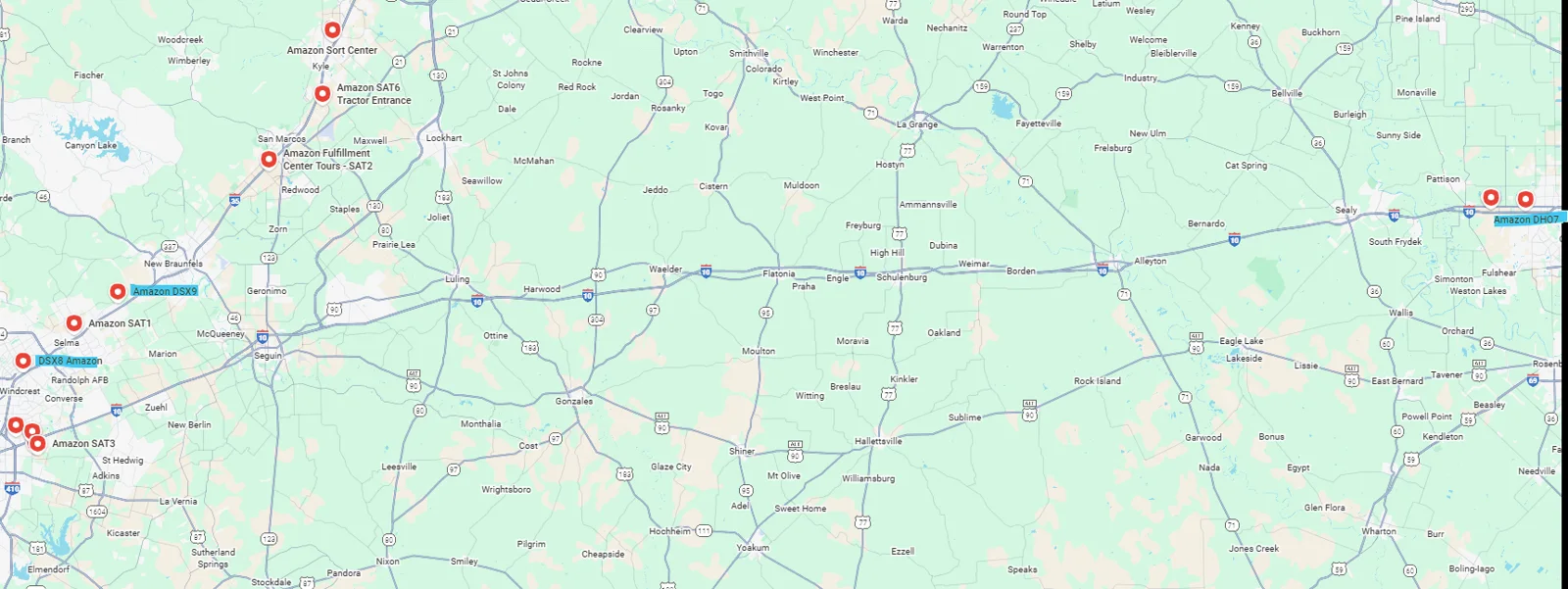
The implication is straightforward. Walmart’s legacy store network doubles as a last-mile asset, particularly outside major metros. In lower-density regions where delivery economics are already fragile, physical proximity becomes the dominant cost lever, and Walmart is already well positioned. That advantage compounds over every mile driven, giving Walmart a structural edge in rural and semi-rural last-mile delivery that is difficult to replicate quickly.
On Road Vehicles
Another critical, and often overlooked, driver (pun intended!) of last-mile unit economics is vehicle type. Simply put, the number of packages a vehicle can carry determines how dense, and therefore how cost-efficient, a delivery route can be.
Amazon’s last-mile network is predominantly built around branded delivery vans, which can carry hundreds of packages per route depending on package mix and geography. These vans are designed to support high route density, especially in urban and suburban areas. Personal vehicles, primarily used through Amazon Flex, tend to show up in more limited scenarios such as same-day delivery or short-term capacity spikes. Because personal vehicles carry far fewer packages, these routes are inherently less economical and are typically deployed only when speed or flexibility outweighs cost.
Walmart’s mix today is closer to the inverse. Personal vehicles play a much larger role in Walmart’s last-mile execution, which structurally limits how dense each route can become compared to a van-based model. Fewer packages per trip mean fewer stops per hour and higher cost per delivery, even when drive distances are relatively short. Walmart’s proximity to customers helps offset this dynamic, but it doesn’t fully replace the density advantages of high-capacity vehicles.
You don’t need an internal dashboard to see the difference. Look around most neighborhoods and you’ll notice far more Amazon vans than Walmart-branded delivery vehicles. That visibility reflects a strategic commitment. Amazon has publicly stated its ambition to have 100,000 electric delivery vans on the road by 2030, signaling a long-term bet on a van-centric last-mile model. Walmart, by contrast, has made few recent large-scale announcements about expanding a dedicated delivery van fleet.
This divergence points to a deeper truth: van-based density only works at scale when supported by sophisticated routing and optimization systems. Which brings us to the final lever in last-mile economics: technology.
Technology
Last-mile technology is some of the most complex in all of fulfillment operations. Accurately delivering a package requires precise understanding of customer locations, road networks, traffic patterns, delivery windows, vehicle capacity, and real-time exceptions - all recalculated continuously as conditions change. The number of inputs required to optimize last-mile routing at scale is enormous, and small improvements can translate into meaningful cost savings when applied across millions of deliveries.
Amazon has treated this complexity as a core competency. Its organizational structure reflects that belief. Amazon has built deep, dedicated technology leadership focused specifically on last-mile execution, supported by specialized engineering and science teams. The investment is visible not just in patents and product features, but also in advanced routing algorithms and real-time optimization capabilities that allow Amazon to continually squeeze efficiency out of a highly complex network.
By contrast, Walmart’s technology expertise in last-mile delivery appears far leaner. A simple comparison of senior technology leadership roles publicly associated with last-mile optimization highlights the difference in emphasis. So, while Walmart can leverage store proximity and physical coverage to simplify the last mile and lower technical complexity, it also limits how much efficiency can be gained as volume increases.
Conclusion: Different Tailwinds, Different Paths to Scale
When you step back and compare Amazon and Walmart across the core drivers of last-mile economics, it becomes clear that each company is benefiting from different tailwinds as they compete for eCommerce dominance.
Amazon’s clearest advantage lies in technology. Years of investment in sophisticated routing, optimization, and real-time decision systems allow Amazon to manage and optimize an exceptionally complex last-mile network. That technical depth enables Amazon to extract efficiency from scale, even as its infrastructure and service promises continue to add operational complexity.
Walmart’s advantage, by contrast, shows up in physical infrastructure. Its co-located inventory model (particularly in rural and semi-urban markets) naturally supports order consolidation and fewer delivery trips per customer. That proximity creates inherent density and lowers last-mile cost without requiring the same level of algorithmic sophistication.
So when people ask, “Who will win?” from an eCommerce economics standpoint, the answer may depend less on who’s ahead today and more on who adapts fastest. Will Walmart invest aggressively enough to close the last-mile technology gap? Or will Amazon find a way to simplify and co-locate its infrastructure?
Early signals suggest Amazon may be moving faster to close the infrastructure gap than Walmart is to close the technology one. Amazon’s recent experiments with physical retail formats point toward a recognition that proximity and consolidation matter in the last mile. Meanwhile, Walmart’s continued emphasis on a Bentonville-centered, in-person talent model may limit how quickly it can scale deep, specialized last-mile technology teams. These are early indicators (not conclusions), but they highlight how seriously each company is pursuing the other’s strengths.
The next phase of eCommerce won’t be decided by speed alone. It will be decided by who can sustainably bend the last-mile cost curve. And that makes this final mile not just a delivery challenge, but one of the most important strategic battlegrounds in retail today.