
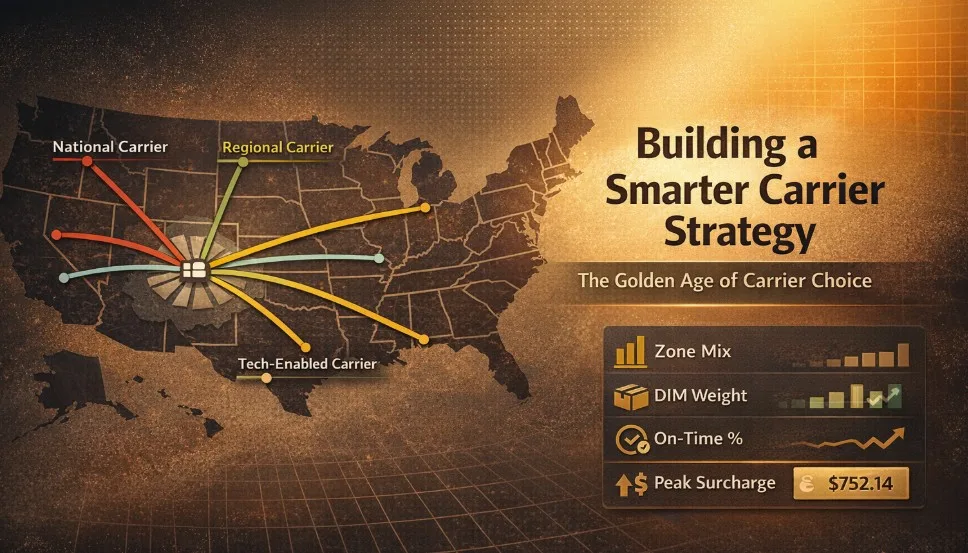
In our last article, we explored how Amazon and Walmart approach last-mile delivery, and how their infrastructure, fleets, and technology investments shape their economics. But most brands aren't Amazon or Walmart. They don't have thousands of facilities, proprietary delivery networks, or billion-dollar technology budgets.
The good news: we're living in the golden age of carrier options in the United States. Regional carriers have scaled into mega-regionals. New entrants have emerged with technology-forward models. Amazon has opened its logistics network to third-party shippers. For brands willing to be strategic, there's more leverage and opportunity than ever before.
More options doesn't automatically mean better outcomes, though. Building a high-performing multi-carrier network requires discipline: knowing your shipment profile, understanding the trade-offs each carrier brings, and designing a mix that balances cost efficiency with delivery performance.
Know Your Profile Before You Negotiate
Most shippers leave money on the table because they negotiate blind. They know their total shipping spend, but they can't articulate the underlying drivers with precision. Carriers know exactly how to price risk and inefficiency into their rates. Before entering any carrier conversation, you need to know your numbers cold.
Zone mix is foundational. Where are your customers relative to your fulfillment locations? A shipper with 60% of volume in Zones 1-4 has fundamentally different economics than one shipping predominantly cross-country into Zones 7 and 8. Zone mix determines which carriers can compete effectively for your business and where regional options become viable.
Package dimensions and weight distribution matter more than most shippers realize. Dimensional weight pricing punishes inefficient packaging. If you're shipping air, you're paying for air. UPS and FedEx have also increased oversize and large package surcharges multiple times in recent years, creating real exposure for shippers with bulky products. On the flip side, many regional carriers have tighter DIM divisors and lower weight caps than the nationals, so what counts as "standard" varies by carrier.
Residential versus commercial split affects how carriers price your business. Historically, carriers have charged residential surcharges based on the assumption that residential stops are less dense and have higher redelivery rates. Commercial deliveries have their own complexities like limited hours, loading dock requirements, and multi-tenant access, but carriers have generally treated residential as the costlier category. UPS and FedEx charge meaningful residential surcharges that add up quickly at volume. Surcharge structures vary across newer carriers. Some don't break out residential as a line item; others bake it into base rates. The only way to know what you're actually paying is to model total landed cost across your full shipment mix, not just compare rate cards.
Service level requirements deserve honest scrutiny, but maybe not in the way you'd expect. Customer research consistently shows that shoppers want to know when a package is coming more than they want it fast. Day-definite commitments, where a carrier guarantees delivery on a specific date, often matter more than raw speed. A customer who knows their package arrives Thursday is happier than one told "2-5 business days" even if the package shows up sooner. Carriers and shipping platforms with strong tracking and reliable day-definite commitments help you set better expectations without paying for speed that doesn't move the needle.
Seasonality and peak patterns affect both your rates and your capacity guarantees. A shipper whose Q4 volume is four times Q2 presents a different risk profile than one with steady demand. Carriers price that variability. One advantage of many regional and mega-regional carriers: they charge lower peak surcharges than UPS and FedEx, or none at all, which can meaningfully change your Q4 economics. But there's a trade-off. UPS and FedEx have been through hundreds of peak seasons. They have institutional muscle memory for what it takes to execute when volume surges. Regional and mega-regional carriers are less battle-tested. A carrier that performs well in March might buckle in December when everyone's volume spikes at once. Before routing meaningful volume to a newer carrier, pressure test their peak readiness – understand their capacity flexibility, their critical injection windows, and where you stand on the pecking order when push comes to shove.
The Golden Age of Carrier Choice
For decades, parcel shipping in the U.S. meant a simple choice: UPS, FedEx, or USPS. That's no longer the case.
The carrier landscape has fragmented in ways that create real opportunity. Regional carriers like CDL Last Mile and GLS have built dense networks in specific geographies. Mega-regionals like OnTrac, Veho, SpeedX, GOFO, Jitsu, and UniUni now cover significant portions of the U.S. population. Amazon Shipping lets brands tap into the same delivery infrastructure that powers Prime. Technology-enabled players have emerged with gig-based workforces and lower cost structures.
This gives shippers leverage they haven't had before, but not all carriers are created equal. Some of the lowest-cost options come with trade-offs that aren't visible on the rate card. Service commitments may be vague: "two to five days" rather than a guaranteed delivery date. Gig-based workforces can introduce variability in quality and consistency. Tracking visibility may be less robust, leaving customers and your support team guessing. Claims processes vary widely when packages go missing or arrive damaged. And returns are a big gap: many newer carriers have limited or nonexistent return networks, which matters if your business has meaningful return volume.
The shippers who win in this environment aren't chasing the cheapest rate. They evaluate carriers across the full picture: cost, service reliability, tracking transparency, exception handling, returns capability, and geographic fit.
Multi-Carrier Strategy, Done Right
There's a strong case for moving beyond single-carrier dependency. Relying entirely on one carrier concentrates risk: service disruptions, capacity constraints during peak, and annual rate increases all hit harder when you have no alternatives. A diversified carrier mix provides negotiating leverage and operational resilience.
But multi-carrier adds complexity. Splitting volume means managing multiple pickup schedules, label formats, and manifesting requirements. Your warehouse team sorts packages by carrier, which adds labor and introduces error opportunities. If you're not careful, the operational cost of managing three or four carriers erodes the savings you expected from rate arbitrage.
The answer isn't to avoid multi-carrier. It's to be intentional about structure. Zone-based routing is often the cleanest approach: use a regional carrier where they have density and cost advantages, fall back to a national carrier for zones outside their coverage. This limits sortation complexity while capturing savings where they exist. A capable multi-carrier shipping platform can automate rate shopping and carrier selection at the package level, but without that infrastructure, multi-carrier becomes a manual burden that's hard to sustain.
Measuring What Matters
Cost efficiency and delivery performance aren't opposing forces, but they require active management.
From a customer's perspective, a great delivery experience is simple: the package arrives when expected, tracking is accurate, and the box isn't destroyed. Miss that bar consistently, and no amount of cost savings offsets the damage to customer lifetime value and brand reputation.
Measure carrier performance with the same rigor you apply to cost. On-time delivery rate is the headline metric, but define "on-time" precisely. Is it delivery by the promised date or by the carrier's service commitment? Make sure your definition reflects what customers actually experience. Track damage and loss rates by carrier too. Low-frequency but high-cost, these events erode margin and goodwill when they happen.
Build scorecards that weigh cost and performance together. A carrier that's 15% cheaper but delivers on-time 85% of the time compared to 97% isn't actually cheaper once you factor in customer contacts, reships, and refunds. Total cost of delivery extends well beyond the line-haul rate.
Putting It Into Practice
If you're looking to optimize your carrier strategy, here's a framework:
First, audit your shipment profile. Pull six to twelve months of data and understand your zone mix, package characteristics, residential split, and service level distribution. Look for outliers: are specific package sizes or destination zones driving disproportionate costs? Those are often where quick wins hide. This baseline makes everything else possible.
Second, benchmark your rates. If you don't know whether your discounts are competitive, you're negotiating in the dark. The most direct way to benchmark is to run a competitive RFP and see what other carriers offer for your profile. Parcel consultants and audit firms also maintain rate benchmarks across their client base. Either approach gives you leverage.
Third, evaluate carrier options across cost, service reliability, returns capability, and geographic fit with your customer base. Don't just chase the lowest rate.
Fourth, pilot before committing. Test a regional or alternative carrier in limited geography or with a subset of volume. Measure actual performance against their promises before routing significant volume their way.
Fifth, build measurement infrastructure. Scorecards and performance tracking let you iterate based on real results, not assumptions.
If you don't have dedicated transportation expertise in-house, the complexity can be overwhelming, and the cost of suboptimal decisions compounds over every package shipped. At Cade Operations Consulting, we help mid-market shippers build carrier strategies grounded in data and designed to deliver both performance and margin.
The Opportunity Ahead
Amazon and Walmart have spent billions optimizing their last-mile networks. You don't need billions, but you do need intention. The carriers, technology, and competitive dynamics have never been more favorable for mid-market shippers willing to do the work.
Build a carrier mix that serves your customers and protects your margin. In an environment where delivery expectations keep rising and cost pressures never let up, that discipline is what separates brands that scale from brands that struggle.