
Every operation pays for poor planning eventually. The only question is how: through overtime, idle labor, missed customer promises, or frustrated employees. Yet many operations still treat planning as one activity: create a forecast, publish a schedule, and hope reality cooperates.
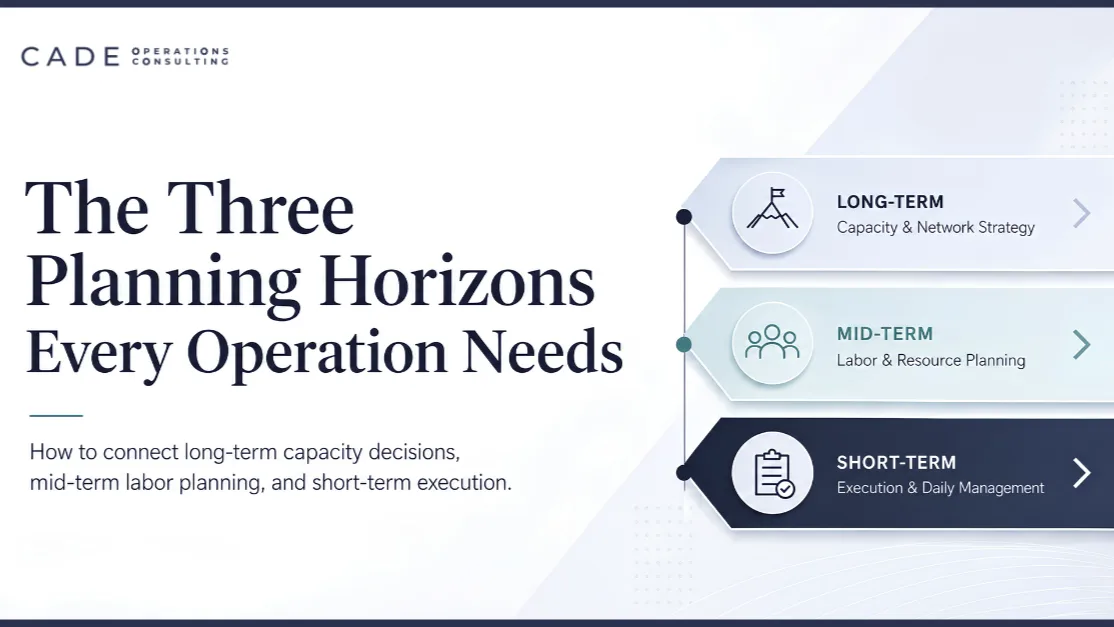
In contrast, strong operations plan across multiple time horizons. Long-term planning creates capacity and flexibility. Mid-term planning puts the right people on the right shifts based on expected demand. Short-term planning adjusts to actual conditions without turning every change into a fire drill.
The goal is not to predict the future perfectly. It is to make the best decisions possible with the information available at the time, so the business can meet customer expectations at the lowest sustainable cost.
One Forecast Cannot Answer Every Question
Leaders often discuss “the plan” as though the operation needs one forecast and one staffing number. In reality, every planning horizon answers a different question. For many fulfillment, distribution, and manufacturing operations, a useful structure looks like this:
| Planning horizon | Typical window | Primary question | Common decisions |
|---|---|---|---|
| Long-term | 6–24 months | What capabilities and capacity will we need? |
|
| Mid-term | Typically 2–12 weeks, extending to 16 weeks depending on hiring and training lead times | When and where will we need people? |
|
| Short-term | Same day – 2 weeks | What has changed, and how should we respond? |
|
The exact windows will vary by business. A manufacturer with a six-month supplier lead time will have different planning windows than an eCommerce fulfillment center that receives most customer orders within days of shipment. What matters is separating decisions by how much lead time they require.
Long-Term Planning Creates the Options
The purpose of long-term planning is to determine what operating capabilities the business will need and how much flexibility to build into the system; for example:
- Whether the network has sufficient building, equipment, and storage capacity.
- Whether the network has buildings in the correct locations to lower end-to-end network costs or enable a new delivery speed profile
- What percentage of labor should be permanent, temporary, part-time, or otherwise flexible.
- How the business will handle peak seasons, launches, promotions, or planned growth.
Long-term planning is not about predicting exactly what the business will need two years from now. It is about making key assumptions explicit, building multiple scenarios, and understanding the operational and financial implications of each one. To think critically, we recommend the following approach:
1. Start with the business and customer strategy
Define what the operation must support, including expected growth, product or channel changes, geographic expansion, and customer service expectations.
2. Identify the variables and ranges that could change the plan
Translate the business and customer strategy into the specific metrics that will drive the long-term plan. Then define a realistic low, expected, and high range for each metric. These may include volume growth, peak demand, product mix, inventory requirements, productivity, labor availability, and transportation or facility costs. The goal is to make the assumptions measurable so they can be tested across multiple scenarios.
3. Compare scenarios
Use the low, expected, and high ranges to model how different assumptions would affect the network. Compare the scenarios across capacity, cost, customer service, labor, and capital requirements. This helps leaders see which constraints appear first, when the current network may no longer be sufficient, and which options perform well across multiple possible futures. For example, the business might model annual growth at 3%, 8%, and 15% to understand when additional shifts, automation, expanded facilities, or new locations may be required.
4. Turn scenarios into decisions
As the scenarios are compared, patterns should emerge in the data. For example, several scenarios may show that the business will eventually need additional capacity on the West Coast to improve delivery speed and reduce end-to-end network costs. That insight gives leaders a strategic direction without requiring them to commit immediately to a specific building. The business can then move into more detailed analysis, such as comparing markets, facility sizes, labor availability, transportation costs, and implementation timing.
Done well, long-term planning gives leaders time to make deliberate choices before capacity constraints force more expensive ones.
Mid-Term Planning Puts the Right People on the Right Shifts
Mid-term planning is where the demand forecast becomes an executable labor plan. The calculation is conceptually straightforward, but the inputs require real operational discipline.
1. Match the planning interval to the customer promise
Start by determining how precisely you need to understand demand and capacity. If the customer promise is 30-minute delivery, you may need to forecast workload and available capacity in 30-minute increments. If the promise is five-day delivery, daily planning may be sufficient.
The planning interval matters because averages can hide meaningful problems. An operation may have enough labor for the day overall but still lack enough people during the two-hour period when most orders arrive. Planning at the wrong level of detail can make the numbers appear balanced while the customer experience suffers.
2. Build demand from the top down
The demand forecast should translate expected customer activity into the workload the operation must complete. Depending on the business, that may include:
Orders.
Units per order.
Production runs.
Units by product type.
Product size, weight, or cube.
Required service level or completion time.
The important point is to understand which variables materially affect labor requirements and include them when the business can make a meaningful assumption about how they will change.
For example, forecasting 10,000 units is not enough if the type of unit significantly changes the work. A promotion on large bags of dog food may require more travel time, different equipment, and slower picking rates than a promotion on small items that can be carried by hand. The unit forecast may be identical, while the required labor is very different.
3. Build capacity from the bottom up
Capacity planning starts with how work actually moves through the operation. The team should understand:
The expected number of employees by shift.
Attendance assumptions by shift.
Direct productivity rates for each major process path (the sequence of steps through which an order or product flows).
The amount of indirect labor required to support the work.
Planned downtime, meetings, training, maintenance, or other events.
Which employees are trained and qualified to work in each process.
Direct labor includes employees completing the primary work, such as picking, packing, receiving, or producing an item. Indirect labor includes the supporting work needed to keep those processes operating, such as leadership, problem solving, material movement, quality checks, and administrative support.
This bottom-up view shows not only how many total labor hours are available, but where and when those hours can actually be used.
4. Identify and close the gap by process path
Finally, compare the required labor hours with the available labor hours for each shift and process path. Once the gap is clear, leaders can decide how to close it. Depending on the size of the gap and how long it is expected to last, the response may include:
Moving cross-trained employees between processes.
Offering planned overtime.
Adding temporary labor.
Hiring into a specific shift and process path.
Adjusting training, maintenance, or other planned work.
Changing when work is released or completed.
The goal is not simply to match total labor with total demand. It is to place the right capability in the right process, on the right shift, at the right time.
Short-Term Planning Manages the Remaining Variance
Even excellent mid-term planning will not eliminate daily variation, and Short-term planning is the disciplined response to those changes.
The key word is disciplined. Short-term planning should not mean that leaders reconsider every decision from scratch several times a day. Instead, the operation should have a playbook with pre-agreed sets of triggers and responses. For example:
| Actual condition | Potential response |
|---|---|
| Volume moderately above plan | Move cross-trained labor, defer lower-priority work, offer voluntary overtime |
| Volume significantly above plan | Add a flex shift, extend operating hours, escalate customer-risk decisions, shift orders to another facility |
| Volume moderately below plan | Pull forward training, preventive maintenance, cycle counts, or workplace organization |
| Volume significantly below plan | Offer voluntary unpaid time off, reduce eligible temporary labor, consolidate work areas |
The specific thresholds should reflect the economics and operating realities of the business. One operation may act when volume moves 5% from plan, while another can absorb 10% without changing labor.
Voluntary unpaid time off can be a valuable short-term lever when volume is lower than expected. Some employees welcome the opportunity, and the company avoids paying people to wait for work that is not coming, but it should be used thoughtfully. Repeatedly publishing schedules and then cutting hours creates financial uncertainty for employees which increases employee turnover risk, and even larger financial impact than a few hours of overtime.
Companies should also review applicable employment agreements and state and local requirements. Some jurisdictions require reporting or scheduling pay when shifts are cancelled or shortened, and different rules may apply to exempt and nonexempt employees.
Connect the Horizons Through a Disciplined Review Process
The three planning horizons work best when information flows between them and when leaders regularly test whether the assumptions used in each horizon still align. A monthly or quarterly business review should examine both the assumptions going into the plans and the operational results coming out. That review should define:
Who owns each planning horizon
Which forecasts and assumptions everyone will use
How forecast accuracy will be measured through back-testing, using metrics such as MAPE and WAPE where appropriate
When each plan becomes fixed and which decisions can still change
What conditions trigger a response
The purpose is not to add more meetings. It is to create a reliable point where leaders can uncover misaligned assumptions before they create large swings in labor, cost, and customer experience.
The Bottom Line
Good planning does not eliminate uncertainty, but it helps leaders act before the operation runs out of good options. Recurring overtime, frequent offers of voluntary unpaid time off, and repeated customer misses are signals that the planning system needs to change. Strong operations use those signals to improve the next plan instead of reacting to the same problem again.
If you are starting from scratch, begin by mapping one planning horizon end to end. Document the decisions it must support, the inputs and assumptions required, the metrics used, and who owns each step. Then confirm whether the necessary data is available and reliable. If it is, start with a simple spreadsheet before investing in an expensive planning system. This allows the team to build and refine the process deliberately and avoids letting a system’s constraints define how the business plans.